
Printing & lamination rollers
Rotogravure printing rollers
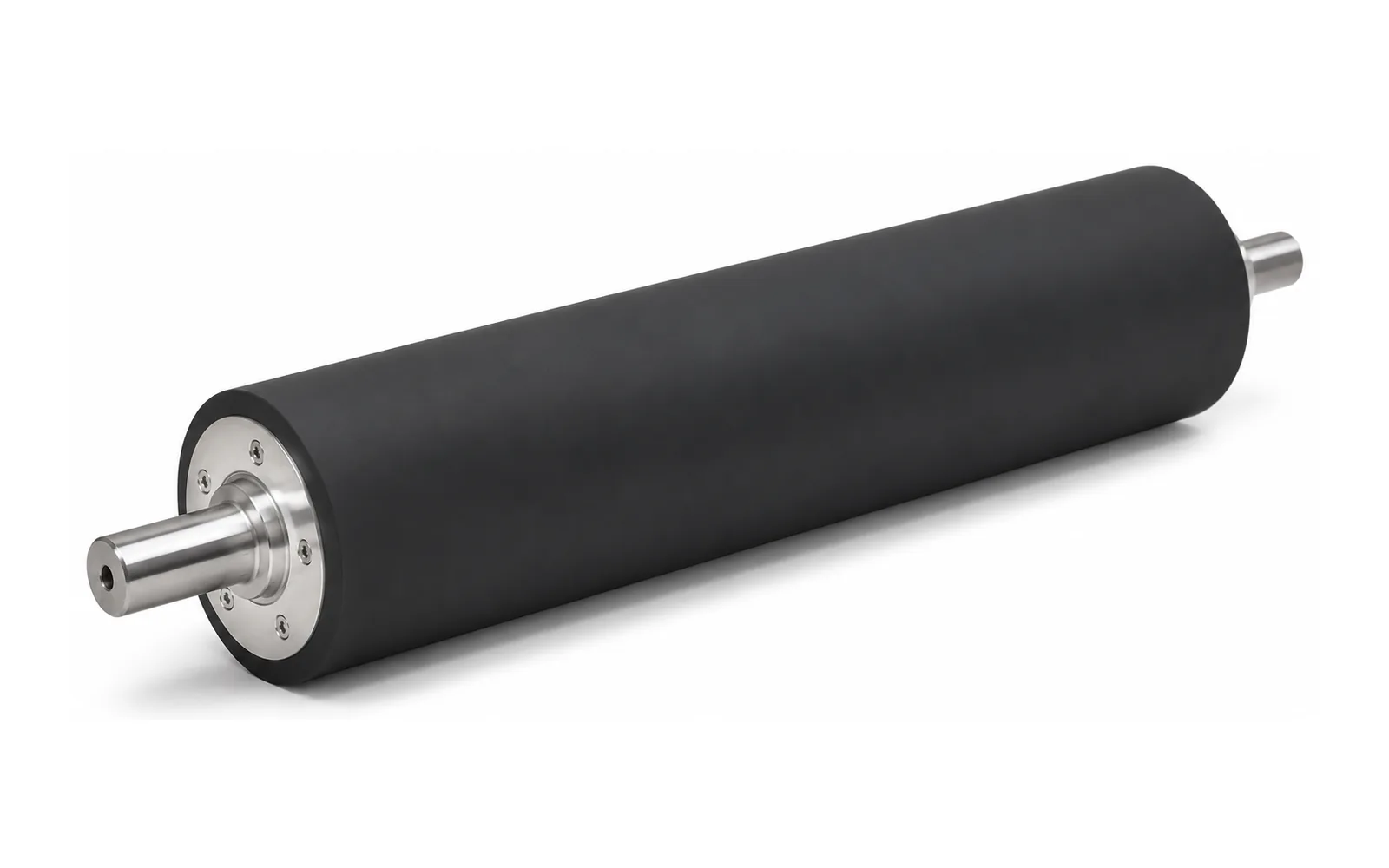
Impression rollers for rotogravure presses. The rubber cover presses the web against the engraved cylinder, so it has to hold an even nip across the full width and resist the solvents in gravure inks.
About our rotogravure printing rollers
Gravure inks are solvent-based and dry fast, and the web often carries a static charge. Covers are compounded for solvent resistance, and anti-static or conductive grades are available to reduce static build-up and the risk it brings near solvent vapour.
Uniform hardness along the face, a ground surface free of porosity and minimal run-out give consistent print density from edge to edge. Rollers are supplied new or re-covered on your existing core.
Key performance features
- Hardness selected for the type of printing or lamination
- No run-out on the finished diameter with reference to the bearing seats
- Porosity-free rubber surface finish
- Dimensional accuracy on diameter, face length and crown
Applications
- Rotogravure printing
- Flexographic printing
- Offset printing
- Tin printing
- Solventless / solvent-based lamination
- Extrusion lamination
- Heat-press lamination
Objectives
- Best printing result
- Long service life
- Anti-static / anti-ozonant compounds
- Conductive compounds where required
- Good abrasion resistance
- Uniform quality across the face
Materials
Typical cover compounds for rotogravure printing rollers. The final choice depends on your inks, chemicals, temperature and hardness requirement.
NBR
Nitrile (NBR)
-30 °C to +100 °C
Oil and solvent ink resistance · Good abrasion resistance · Cost-effective
CR
Neoprene (CR)
-40 °C to +110 °C
Moderate oil resistance · Good weathering · Tough and resilient
EPDM
EPDM
-50 °C to +150 °C
UV and water-based inks · Hot water and steam · Ozone and weather resistance
How we work
From your old roller or drawing to a roller that runs true
01
Roller review
We check your drawing or old roller, confirm diameter, face length, journals and the hardness you need.
02
Cover selection
A cover compound is proposed for the inks, chemicals and temperatures your roller sees in service.
03
Core and covering
The core is prepared or made new, then the cover is applied without porosity and cured.
04
Grinding and inspection
Ground true to the bearing seats, finished as specified, and checked for hardness and run-out before dispatch.
Industries using rotogravure printing rollers
FAQ
Rotogravure Printing Roller: common questions
Do you supply anti-static rotogravure rollers?
Yes. Anti-static and conductive compounds are available for rotogravure impression rollers. Tell us the ink system and press speed when you enquire.
Can you re-cover my existing roller?
Yes. The old cover is stripped, the core is inspected and prepared, and a new cover is bonded, cured and ground to size. Re-covering a sound core is usually faster and cheaper than a new roller.
What details do you need to quote?
A drawing or the old roller, finished diameter, face length, journal details, required hardness in Shore A and what the roller contacts (ink, solvent, adhesive, film, heat). Send these through our request a quote form.
Related technical guides
Related rollers
Request a quote for rotogravure printing rollers
Share your roller drawing or sample, required hardness and what it contacts. Our team will recommend a cover and respond with a quotation.