
Rubber & polymer covered rollers
Crook rollers (diamond pattern rubber rollers)
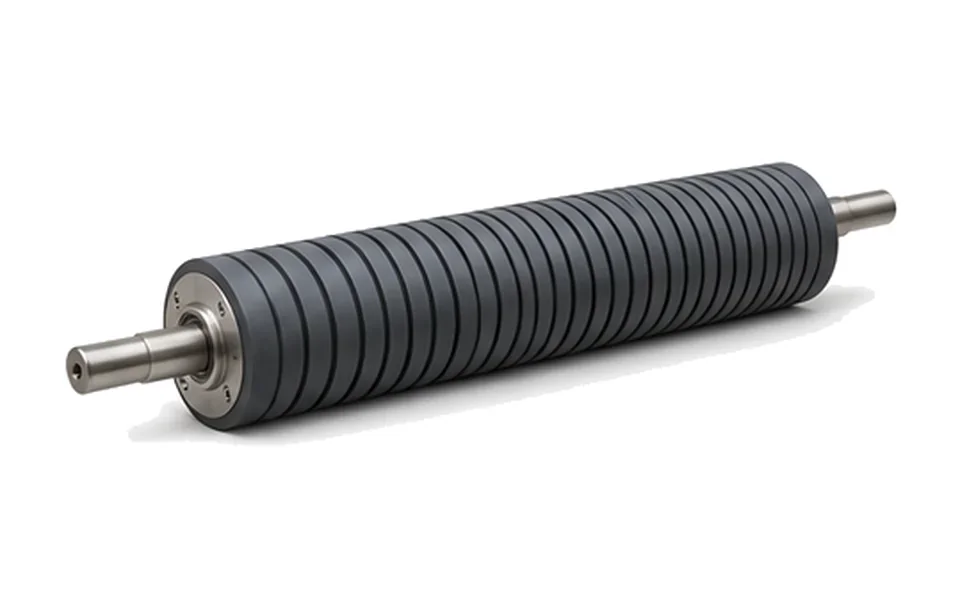
Crook rollers have a diamond (criss-cross) pattern cut into the rubber cover. The pattern adds grip and lets trapped air escape, which helps feed, spread and wind webs without slipping or wrinkling.
About our crook rollers
The groove pattern, pitch and depth are chosen for the material being handled. Typical uses are feed and draw rollers on converting lines, textile machines and winding equipment.
The cover compound and hardness are selected for the duty, held uniform within ±1 Shore A, and the pattern is cut after grinding so the roller runs true.
Key performance features
- Hardness selected for the application
- Uniform hardness across the surface, within ±1 Shore A
- No run-out on the finished diameter with reference to the bearing seats
- Wide choice of covers to resist chemicals and solvents
- Porosity-free surface finish
- Polymer selection and compounding matched to the duty
- Technical support on site and online
Applications
- Feed and draw rollers
- Web spreading
- Textile machines
- Winding and rewinding
Objectives
- Best result in the application
- Long service life
- Anti-static
- Good abrasion resistance
- Uniform quality
Materials
Typical cover compounds for crook rollers. The final choice depends on your inks, chemicals, temperature and hardness requirement.
NBR
Nitrile (NBR)
-30 °C to +100 °C
Oil and solvent ink resistance · Good abrasion resistance · Cost-effective
NR
Natural Rubber
-50 °C to +80 °C
High resilience and grip · Abrasion resistance · Economical
EPDM
EPDM
-50 °C to +150 °C
UV and water-based inks · Hot water and steam · Ozone and weather resistance
CR
Neoprene (CR)
-40 °C to +110 °C
Moderate oil resistance · Good weathering · Tough and resilient
How we work
From your old roller or drawing to a roller that runs true
01
Roller review
We check your drawing or old roller, confirm diameter, face length, journals and the hardness you need.
02
Cover selection
A cover compound is proposed for the inks, chemicals and temperatures your roller sees in service.
03
Core and covering
The core is prepared or made new, then the cover is applied without porosity and cured.
04
Grinding and inspection
Ground true to the bearing seats, finished as specified, and checked for hardness and run-out before dispatch.
Industries using crook rollers
FAQ
Crook Roller: common questions
Can you match the pattern on my existing crook roller?
Yes. Send the roller or a photo with the pitch, groove width and depth, and we will match it or suggest a pattern for your material.
What details do you need to quote?
A drawing or the old roller, finished diameter, face length, journal details, required hardness in Shore A and what the roller contacts (ink, solvent, adhesive, film, heat). Send these through our request a quote form.
Related technical guides
Related rollers
Request a quote for crook rollers
Share your roller drawing or sample, required hardness and what it contacts. Our team will recommend a cover and respond with a quotation.